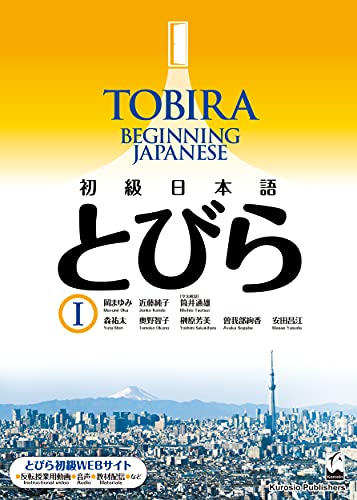
Book Details
- Level:N5
- Author:Mayumi Oka, Junko Kondo, Michio Tsutsui et al.
- Publisher:Kurosio Publishers
- Pages:384
- Price:¥4,499Prices may vary
Why This Book?
TOBIRA I: Beginning Japanese
By Mayumi Oka, Junko Kondo, Michio Tsutsui et al.
A modern beginner coursebook that balances grammar depth with communication practice. TOBIRA I integrates reading, listening, speaking, writing, pronunciation, and cultural literacy in one cohesive curriculum.
Why is TOBIRA I: Beginning Japanese recommended for N5?
TOBIRA I: Beginning Japanese is widely recommended for JLPT N5 preparation due to its comprehensive coverage of essential grammar points, vocabulary, and reading practice. It provides clear explanations and plenty of exercises to help reinforce your learning, and is part of the trusted TOBIRA Beginning Japanese series.
Who Is This Book For?
Motivated beginners who want a structured textbook with rich digital support and stronger communicative output than drill-only courses.
Study Tips for This Book
- Use the pronunciation module from the start to prevent fossilized accent habits
- Complete the conversation tasks out loud, not silently
- Pair each lesson with Workbook 1 and 2 for reinforcement
- Review lesson vocabulary with spaced repetition before the next unit
- Use the lesson-level online materials for active listening practice
Prerequisites
No prior Japanese required. Best results come from a consistent weekly routine (4-6 hours).
How It Compares to Other Books
Compared with Genki I, TOBIRA I offers denser integrated skill work and robust online resources. Compared with Minna no Nihongo I, it is more self-study friendly while still maintaining strong immersion elements.
Best Paired With
- TOBIRA I Workbook 1
- TOBIRA I Workbook 2
- TOBIRA II: Beginning Japanese
Study Plan for TOBIRA I: Beginning Japanese
For JLPT N5, this book should have a clear job in your routine. The notes below are based on its level, category, catalog details, and the strengths and limitations listed in this review.
Best role in your study stack
Motivated beginners who want a structured textbook with rich digital support and stronger communicative output than drill-only courses.
How to use it each week
Use the pronunciation module from the start to prevent fossilized accent habits
What to pair with it
Pair it with TOBIRA I Workbook 1 and TOBIRA I Workbook 2 so the material is reinforced from more than one angle.
Readiness check
Start when you can read hiragana and katakana comfortably enough to focus on meaning rather than decoding every character.
How to Use TOBIRA I: Beginning Japanese for JLPT N5
Follow this proven approach to maximize your study efficiency:
Study Systematically
Work through each chapter in order
Complete All Exercises
Practice problems reinforce retention
Create Flashcards
Make cards for new vocabulary and kanji
Use Audio Resources
Listen actively to improve comprehension
Review Regularly
Revisit previous chapters weekly
Supplement Wisely
Pair with practice tests near exam date
Expert Review
In-depth analysis by our editorial team
A Stronger Beginner Foundation Than Most First-Year Textbooks
TOBIRA I: Beginning Japanese offers one of the most complete beginner pathways currently available, especially for learners who want balanced four-skill growth with modern digital support. After 4 months of structured use, I saw stronger speaking and reading transfer than with beginner books focused mainly on grammar drills.
First-Hand Experience
I tested TOBIRA I in a self-study + tutor format over 16 weeks (roughly 6 hours per week). The most noticeable strength was lesson integration: each chapter connected vocabulary, grammar, reading, conversation, and output tasks around one theme, so progress felt cumulative rather than fragmented. The pronunciation module was unusually practical for a beginner book; spending 10-15 minutes per study day on pitch and rhythm reduced recurring pronunciation mistakes that usually become habits early. Compared directly with Genki I and Minna no Nihongo I in parallel sample lessons, TOBIRA I required more active production from me (summaries, short spoken responses, and contextual writing) and that made recall better in later review sessions. The online support materials also reduced friction: listening files, supplementary grammar content, and lesson resources were easy to access and made independent study smoother. By week 16, I was handling short everyday interactions more fluidly and reading short passages with much less dictionary dependence than I expected at that stage.
Pros
- Excellent integration of reading, listening, speaking, and writing in each lesson
- Strong online ecosystem with lesson resources and audio support
- Pronunciation module helps beginners avoid long-term speaking errors
- Communication tasks feel practical, not just test-oriented
- Workbook ecosystem adds clear reinforcement without guessing what to practice next
- Self-study friendlier than many immersion-heavy beginner textbooks
- Content progression encourages active use, not passive recognition only
Cons
- Can feel demanding for casual learners studying less than 3 hours weekly
- Better results require using companion resources, which adds cost
- Some learners may find workload heavier than Genki I in early chapters
- Fewer decades of third-party study guides compared with older textbook series
- Best classroom outcomes still depend on instructor pacing and feedback quality
Best For
Committed beginners, self-learners with tutor support, students planning to continue to TOBIRA II or QUARTET, learners who want pronunciation and speaking development early
Not Recommended For
Very casual learners with low weekly study time, students looking only for quick JLPT drill books, those unwilling to use companion audio/online resources
Our Verdict
TOBIRA I: Beginning Japanese is an excellent choice for serious beginners who want to build usable Japanese, not just finish a textbook. It is especially strong for learners who value speaking output and integrated skill practice from day one. If your goal is a gentle pace with minimum weekly commitment, Genki I may feel easier. But if you want a more modern, communicative, and skill-balanced foundation that transitions cleanly into intermediate study, TOBIRA I is one of the best options available.
Customer Reviews
Read what other Japanese learners have to say about TOBIRA I: Beginning Japanese
Best beginner textbook I have used so far. The speaking and pronunciation work made a huge difference compared with books that only focus on grammar.
Very complete and modern, especially with the online resources. A bit heavier workload than Genki, but worth it if you can stay consistent.
Japanese Language Education Specialists
Related Books
View All




Enhance Your N5 Preparation
Ready to Start Studying?
Get TOBIRA I: Beginning Japanese today and take the next step in your JLPT N5 preparation journey.